
Nobody from the SABS will ever stand on your site. SANS 10299 is a voluntary standard right up until a tender consultant, a bank's bond department or a lawyer shows up — and in 2026 all three are showing up more often. Here is what each one actually checks.
First, where these numbers come from
The standard itself sits behind the SABS paywall — nine parts (0 through 9, with no Part 3), priced from R251.85 to R525.55 per part, about R3,336 for the full set. Every part is still the 2003 edition except Part 6, revised in 2009. So we are not going to quote clause numbers at you. The construction figures below come from the DWS Minimum Standards and Guidelines for Groundwater Resource Development (April 1997) — the government document that 2025 tender specs still copy word for word, right next to their "drilling per SANS 10299:2003" clause — plus those tender documents themselves.
On tender work, the consultant is the inspector
Government jobs put a hydrogeological consultant on site with real teeth. The test that bites is the witnessed verticality check: a plumb bob down the hole, and if deviation exceeds two-thirds of the casing inside diameter over 30 m, the hole is declared lost. You redrill at your own cost. Not a fine, not a warning — a free borehole for the client.
The same consultant signs off backfilling and sealing before those line items get paid.
The seal nobody can see
The sanitary seal is the classic skip, because once the collar is cast it is invisible. The DWS recipe is specific: mix 2 kg of bentonite into 25 litres of water first, then add one 50 kg bag of cement. The seal must extend at least 5 m down the annulus, and backfilling stops about 5 m from surface to leave room for it. Siting is part of the same protection logic — the guideline puts pit latrines 25 to 50 m away from the hole, depending on geology and water table.
The paperwork pack the bank demands
Off tender work, the inspector is whoever is paying. Banks require a yield test certificate before approving a bond on a property where the borehole is the primary water source. The full completion pack a compliant driller hands over:
- Driller's log — depths and diameters, casing details, water strikes and blow yields. Tenders make final payment conditional on it.
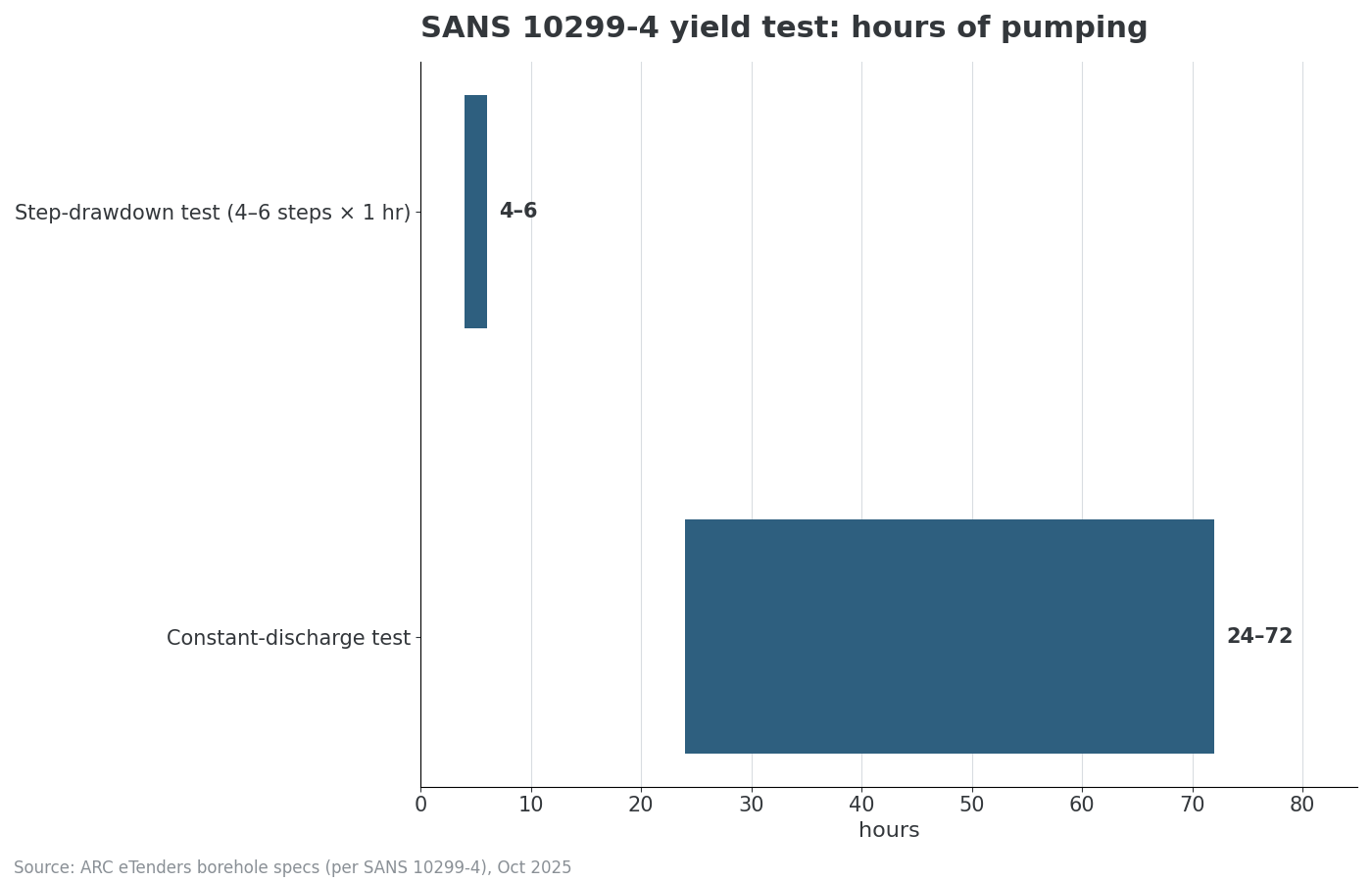
- Yield test certificate per SANS 10299-4 — a step test of 4 to 6 one-hour steps, then a constant-discharge test of 24 to 72 hours where the pump rate must hold within 5% or the test restarts, then recovery monitored to within 5% of total drawdown.
- Water quality analysis per SANS 241 from a SANAS-accredited lab.
- Electrical CoC for the pump installation.
- Pump commissioning data, plus the main strike depth for the pump installer.
Hand that file over on every job — including cheap residential ones — and you are ahead of most of the market.
When it goes wrong, the driller is in the firing line
A reported case from May 2026: an unauthorised borehole in Killarney, Joburg, drilled above the Gautrain tunnel, caused seepage into the tunnel, suspended services between Park and Rosebank, and left a repair bill over R1 million. The Gautrain Management Agency is pursuing the owner — and potentially the contractors. Checking consents and servitudes before you set up is not admin. It is what keeps your rig out of a courtroom.
Build for the spec
Government specs ask for rigs that can reach 200 m at 254 mm diameter on occasion — worth reading our guide on choosing a rig before you tender. Our workshop in Mokopane builds for exactly this market. Chasing tender work and want to talk rig capability against the paperwork above? Talk to Drillbuilders.
Sources
- DWS Minimum Standards and Guidelines for Groundwater Resource Development — verticality test, sanitary seal recipe and depths, latrine setbacks, 200 m / 254 mm rig capability, Apr 1997
- ARC eTenders borehole specification — SANS 10299-4 yield test steps, durations and 5% criteria, driller's log as payment condition, Oct 2025
- BWA journal on SANS 10299 — the standard's nine-part structure, editions and SABS prices, prices as at 13 Jan 2025
- BWA borehole checklist — bank yield-certificate requirement for bonds and the completion paperwork pack, page live Jul 2026
- IOL — Killarney borehole damage to the Gautrain tunnel and the R1 million-plus repair bill, 18 May 2026