Jack Types
Nine kinds of jack, what each one is honestly good for, and the one rule that keeps people alive underneath a machine: a jack lifts, it does not hold. Stands or cribbing carry the load before anybody puts a shoulder under it. Everything else on this page is detail hanging off that sentence.
A jack lifts. Something else holds.
A jack is a temporary machine and it knows it. Strip any of them down and you find one component standing between the load and the ground: a seal, a thread, or a pawl on a tooth. A seal can pass. A release valve can weep past its seat. A pawl can ride up over a rounded tooth. A base can settle twenty millimetres into a soft yard and turn a level lift into a lean.
None of that matters while you are standing beside the machine with a hand on the handle, because you can see it happening and step back. All of it matters the moment your chest is underneath.
- Lift with the jack. Slowly, watching the jack rather than the load.
- Transfer to stands or cribbing. Rated axle stands, or squared hardwood cribbing stacked in a crib pattern. Under designed support points, not under a sump, a tank, a pipe or a floor pan.
- Test it before you trust it. Push the machine hard, sideways, at chest height. If it rocks, start again. Better to find out standing up.
- Leave the jack in place. Wound down a few millimetres so it carries nothing, but is there to catch the drop if the stand does something you did not plan for. It costs nothing to leave it.
A jack that is holding a load while someone works under it is not a jack in use. It is a fall waiting for a trigger.
From the olive press to the boot of a car
Every jack on this page is one of three ideas, and two of them are older than the machines they lift.
The screw came first. Greek and Roman growers were pressing olives and grapes with screw presses by the first century AD — Pliny the Elder writes them up as a recent improvement of his own lifetime — and the whole trick of a screw jack is already sitting there: a coarse thread turns a long, easy sweep of your arm into a short, enormous movement along an axis, and then refuses to unwind on its own. Nothing about that has been improved on. A bottle jack is a genuinely different machine, but the screw jack under a trailer landing leg is an olive press in steel.
The second idea took much longer to become a tool. Blaise Pascal set out in the seventeenth century that pressure in a confined fluid acts equally in every direction, which is another way of saying that a small piston pushed hard will move a big piston easily. Turning that into hardware took another hundred and thirty years and Joseph Bramah, who patented a hydraulic press in England in 1795. Early presses leaked badly enough at pressure to be close to useless. The fix is credited to a young Henry Maudslay working in Bramah’s shop: a leather cup seal shaped so the pressure inside it forces its lip harder against the cylinder wall. The harder you push, the better it seals. Materials have moved on and that idea has not — it is why hydraulic jacks exist at all, and why a tired one gives itself away by weeping rather than bursting.
Portability came later again. Richard Dudgeon, a New York machinist, patented a portable hydraulic jack in the early 1850s and went straight after the screw jack’s work in shipyards, foundries and the railway shops. Same lift, a fraction of the winding, and one man could carry it.
The third idea is a rack and a pawl, and it is a farm tool. The tall mechanical jack that everyone calls a hi-lift was built in Bloomfield, Indiana by the Harrah family from the early years of the twentieth century, and sold for generations as the Handyman Jack: one tool to lift a wagon out of the mud, stretch a fence, pull a post and clamp a repair in a field a long way from a workshop. It is still made in the same town. It is also, by a distance, the most dangerous jack here — for exactly the reason it is useful, which is that it holds a load a metre in the air on a narrow steel beam while your hands are on a long lever.
The scissor jack has no such story, and that is the point of it. It arrived as a cheap, flat, foldable thing to put in a car boot next to the spare wheel, and it was designed down to that job and no further.
Lift, transfer, hold
Every jack, and where it belongs
| Jack | What it is | What it is for | What catches people out |
|---|---|---|---|
| Hydraulic bottle jack | A short, fat cylinder with a ram out of the top and a hand pump alongside. Pascal in a steel pot. | Big capacity in a small package, straight up. Axles, beams, pressing jobs, wheel changes on heavy vehicles. | Its collapsed height is tall, so it often will not go under a low chassis at all. It only works near vertical — lay it over and the pickup uncovers and it stops pumping. A spongy, bouncy lift is air in the oil; a jack that sinks back down with the load on has a seal or a release valve that is not sealing. Neither of them is a heavy load. |
| Floor (trolley) jack | A long horizontal ram working a lifting arm through a linkage, with a saddle on top and castors underneath. | Fast, low-entry lifting on a flat, hard workshop floor. | The saddle travels through an arc as it rises, so it drags the lifting point sideways. It is designed to relieve that by rolling. Put it on gravel, sand or a soft yard and the castors dig in, the jack cannot follow, and it side loads itself until it tips. |
| Scissor jack | Two pairs of arms in a diamond, pulled closed by a screw across the middle. | A roadside wheel change on a light vehicle. That is the whole job. | It is stable only in the plane of the diamond. A shove from the side folds it flat. The screw and the pivots are the least maintained parts anyone owns, and they are usually matched to one specific vehicle rather than to a capacity. |
| Screw jack (jack screw) | A coarse Acme or square thread running in a nut body, turned by a bar or a ratchet. No fluid anywhere. | Slow, controlled lift that stays where you left it. Trailer landing legs, levelling feet, machine bases, shoring. | The thread is self-locking, which is exactly why it holds — and also why it is slow and why it is easy to wind out too far. Thread engagement is the whole strength of it: a jack extended to its last few turns has very little left holding the load up. |
| Hi-lift (rack or farm jack) | A drilled steel beam, a climbing runner carrying two spring-loaded pins, a lifting nose and a long handle. | Enormous lift height on rough ground, plus winching, spreading and clamping. A recovery tool first and a lifting tool second. | The handle. If the runner slips or a pin misses its hole, the load drives the handle up through its arc with everything the machine weighs behind it. This jack has a genuine injury record and it is nearly always the handle. Both hands on it, head out of the arc, and clipped to the beam whenever it is not being worked. |
| Pneumatic jack | Either an air-over-hydraulic bottle jack, or a stack of inflatable bags fed from shop air or a compressor. | Fast repeat lifting where there is air on tap. Bags spread their load over a wide footprint, which suits soft or uneven ground. | Air is compressible, so a bag is a spring, not a support — it keeps moving under a shifting load. Bags puncture on anything sharp and lose height as they lose pressure. An air-over-hydraulic unit is a hydraulic jack with an air pump; the hydraulic rules apply. |
| Ratchet (lever) jack | A toothed rack lifted a tooth at a time by a pawl on a lever. The same pattern is long familiar from railway work, where it is still called a track jack. | Steady inching on rough or dirty ground, and pulling and spreading in some forms. | The pawl is the entire safety system. A rounded tooth, a bent rack or a worn pawl spring lets it skip, and it drops the height of a tooth instantly. Inspect the teeth before you trust it, and never stand where the lever will reach you. |
| Toe jack | A jack body with a lifting toe at the very bottom as well as a saddle on top — usually hydraulic, sometimes screw. | Getting under something with almost no clearance: base plates, skids, compressors, a machine being walked across a workshop floor. | The toe is normally rated lower than the top saddle on the same jack, and people read the one big number on the label. Load has to bear on the full width of the toe, not on its tip, and the load must be free to rise straight up. |
| Transmission jack | A hydraulic jack with a wide cradle, tilt screws and straps, on a wheeled or telescopic base. | Holding and steering a gearbox, transfer case or pump while it comes off the machine. | It is a handling tool, not a load holder. The rating is modest next to a floor jack, and it turns unstable the moment the load is high and off-centre. Strap the load into the cradle every time, even for a two-minute move. |
Names drift by supplier and by country. A “bottle jack” and a “hydraulic jack” are usually the same thing; a “farm jack”, a “rack jack” and a “hi-lift” are the same pattern of tool. Order on capacity, collapsed height and stroke, never on the name alone.
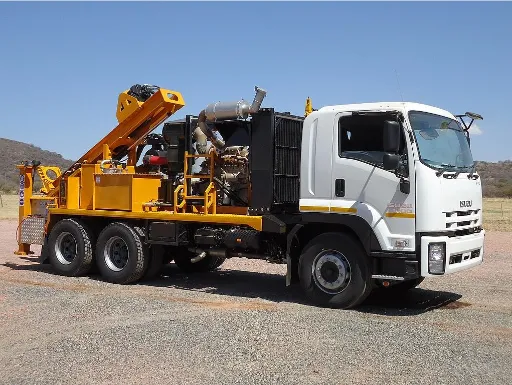
SAR210 Post Hole Rig
The SAR210 stands on its outrigger jacks for every hole — 100 to 430 mm post holes from a Powerstar 6×6.
See the SAR210 — price on requestChoosing and using one without hurting anybody
- Rated capacity is a bench figure, not a target. The number stamped on the body is a rated load set on a bench — vertical, on flat steel, in controlled conditions. On a machine you are also guessing at the weight distribution, and the guess gets worse the moment the ground slopes. Work well inside the rating, and never in the last of the stroke where the ram is longest and least supported. Test standards and the design factors behind them vary between makers and markets. verify with maker
- Ground bearing under the base is the part everyone skips. Bearing pressure is load divided by base area, and the base of a bottle jack is small. On concrete it is a non-issue. On gravel, dirt, tar in the heat or a yard that has been rained on, spread it — a steel plate or a slab of hardwood under the base. Timber also tells you something: if it is crushing, you are overloaded or badly placed.
- Side loading is what actually breaks jacks. A ram and a cylinder are a lifting column. They are not a beam and they are not a hinge. As anything rises, the point you are lifting swings along an arc. A trolley jack handles that by rolling on its castors; a bottle jack on a plank cannot, so the jack leans a little further every stroke. Stop at the first sign of a lean, lower it, and reset.
- Collapsed height and stroke decide whether a jack is any use at all. Two dimensions, and they are the ones nobody checks before buying. A jack that will not go under the machine is scrap metal, and a jack that runs out of stroke halfway to the stand height is worse, because you find out with the load up.
- Lift only on points designed to take it. Axle tube, chassis rail, a purpose-made jacking pad. Not a sump, a fuel or hydraulic tank, a floor pan, a manifold, a hose run or a pipe. On our machines the designed points are the ones we will happily mark on a drawing for you.
- Two jacks is not twice as safe. Load sharing between two jacks is not something you can control by feel. One takes most of it, and when it moves the other becomes a pivot. Where you genuinely need two lifting points, lift one end at a time and get stands under each as you go.
- Crack the release valve slowly. A quarter turn. The valve is a metering device on the way down, and a jack dropped fast is a jack that shock loads everything under it — including the stands you were about to trust. There is more on how these valves behave in our valve types reference.
- Look after the ram, not just the oil. Weld spatter, grinding sparks and rust pit the chrome, and a pitted ram cuts the seal on every stroke after that. Wipe it, keep it out of the sparks, and store bottle jacks standing upright with the ram down.
One tool, one hazard, and it is the handle
A hi-lift earns its place in a bakkie because it does several jobs and reaches the better part of a metre. It stays dangerous because the load path runs through two small pins into holes in a beam, and the operator stands inside the arc of a lever that is being held down by the entire weight of whatever is up in the air.
- Two hands, always. One hand cannot control the handle if it starts to come up, and a hand that has let go cannot stop it either.
- Head and chest out of the sweep. Stand to the side of the arc, not in it. This costs nothing and it is the single thing that turns most of these incidents into a story rather than an injury.
- Clip the handle to the beam whenever you are not working it. A handle standing up under load is a loaded lever waiting for someone to walk into it. The clip exists for exactly this.
- Keep the beam clean and straight. Mud in the holes, a bend from being used as a lever, or a runner that has been dropped — any of those and the pins stop finding home reliably.
- Never work under a load held on a hi-lift. This one is not a preference. The runner can slip on the way up, on the way down, and while nobody is touching it at all.
Where jacks live on our machines, and where they honestly do not
Some of this list is short on purpose. A drilling rig is not a car, and half the jacks above never come near one.
- The rig’s own levelling legs are not jacks in this sense. They are hydraulic cylinders on the machine’s own circuit, with holding valves to stop them running away if a hose lets go. Their job is to level the deck and take the reaction of the mast while drilling. They are not a substitute for stands, and a machine standing on its legs is still a machine on hydraulics. If a person is going under it, it goes on cribbing. The circuit that feeds them is covered in our hydraulic fitting types and valve references.
- Bottle jacks live in the toolbox. Wheel changes and axle work on the carrier or the trailer. They are the right tool for a heavy axle in a spot where there is no floor to roll a trolley on.
- Toe jacks live in the workshop. Building and shifting rotary heads, compressors, decks and base frames, where you need to get under a plate with almost nothing to spare.
- Screw jacks live on the trailers. Landing legs and levelling feet. Slow, self-locking, and they hold their position with the load on, which is what a parked trailer needs. The coarse threads and coupling nuts on those legs are the same family we cover in our nut types reference.
- Hi-lifts live on the support vehicle. Recovery, not maintenance. In the Limpopo bush a bakkie in a wash-away is a normal afternoon. On the rig itself, almost never.
- Scissor jacks belong nowhere near any of it. Their capacity, their footprint and their sideways stability are all matched to a family car. Say so out loud when one appears on a site.
- Transmission jacks are workshop-only. Dropping a gearbox or lifting a pump into place on the bench. Strapped, every time.
What actually fails in the field, in our experience: seals, because a jack that lives in a dusty toolbox on a rig has a much harder life than one in a workshop, and grit on a ram is what kills a seal. After that, chrome pitted by welding and grinding, and air in the oil from a jack that has been carried on its side. None of those are dramatic. All of them show up as a jack that sinks slowly under load, which is exactly the failure you do not want to discover while you are under the machine. If a jack creeps, retire it. They are the cheapest item in this whole conversation — see what we stock in the shop, or work through the rest of the Knowledge section.
What we are deliberately not telling you
- Capacity ratings and how much to derate them. Rating methods and the design factors behind them differ by manufacturer and by market, and a jack sold in one place may be tested to a different rule than the same-looking jack sold in another. We are not going to print one universal percentage as though it applied to your tool. Read the plate and the manufacturer’s manual for the jack you actually own. verify with maker
- Hi-lift injury numbers. The injury pattern is well established and appears in the manufacturers’ own manuals and warnings. We could not find a South African injury statistic we would be willing to quote, so we are not quoting one. Treat the absence of a number as an absence of data collection, not as evidence that it is rare. no published figure
- Allowable ground bearing on your site. Spreading a jack base is easy advice to give and impossible for us to put numbers on from here. It depends on the soil, how wet it is and what has been driven over it. Nothing on this page models it. not modelled
- Air bag capacity against height. A pneumatic lifting bag does not hold the same capacity across its full inflation — the rating falls as it rises and the shape changes. That curve is specific to the model and comes from the bag maker, not from us. verify with maker
- Torque, pressure and stroke figures for specific jacks. There is no table of them here on purpose. A generic figure applied to the wrong tool is worse than no figure. Ask us about a specific jack or a specific lift on one of our machines and we will give you that one. no published figure
Getting under one of our rigs?
Tell us the model and what you need to reach, and we will send you the mass on that axle, the designed lifting and support points, and what we put under it in our own workshop. We build these machines in Mokopane, so the figures come from the people who weigh them and assemble them — not from a generic chart.
Ask our workshop