SAR200 vs A200: chain feed or direct feed?
These are the two 400 m rigs in our range, and on paper they look like twins: same depth, same 10 inch hammer class, the same two rotary-head options. The real difference sits in the tower — one feeds through a leaf chain, the other straight off the cylinder — and that one choice decides the height of the rig, the force at the bit, and how many parts can ever wear. We build both, and this page is the honest tiebreaker.
The closest call in our range
We have been building drilling equipment in Mokopane since 1999, and no two machines in our yard get compared against each other more than these. Most rig choices settle themselves on depth or access: a 200 m rig against a 400 m rig is really a question about your market, and a truck rig against a trailer rig is a question about your sites. The SAR200 and A200 give you neither escape: both reach 400 m, both swing up to a 10 inch hammer, both mount on the same 6×4 truck class, and both take exactly the same rotary heads.
What separates them is a genuine engineering fork: how the rotary head is driven up and down the tower. The SAR200 feeds through a leaf-chain system at a 1:2 ratio — a functional design that buys speed, force and a tower that never grows taller than itself. The A200 couples the head directly to the longest feed cylinder we build — a reliability design that removes the chains, and with them a whole family of wear and adjustment, at the cost of height and push-down. Neither is the better rig; they are different answers to the question of what you want to maintain and where you plan to drill. Both answers come out of the same workshop, so we have no reason to steer you — only to explain.
Two 400 m rigs, one engineering fork
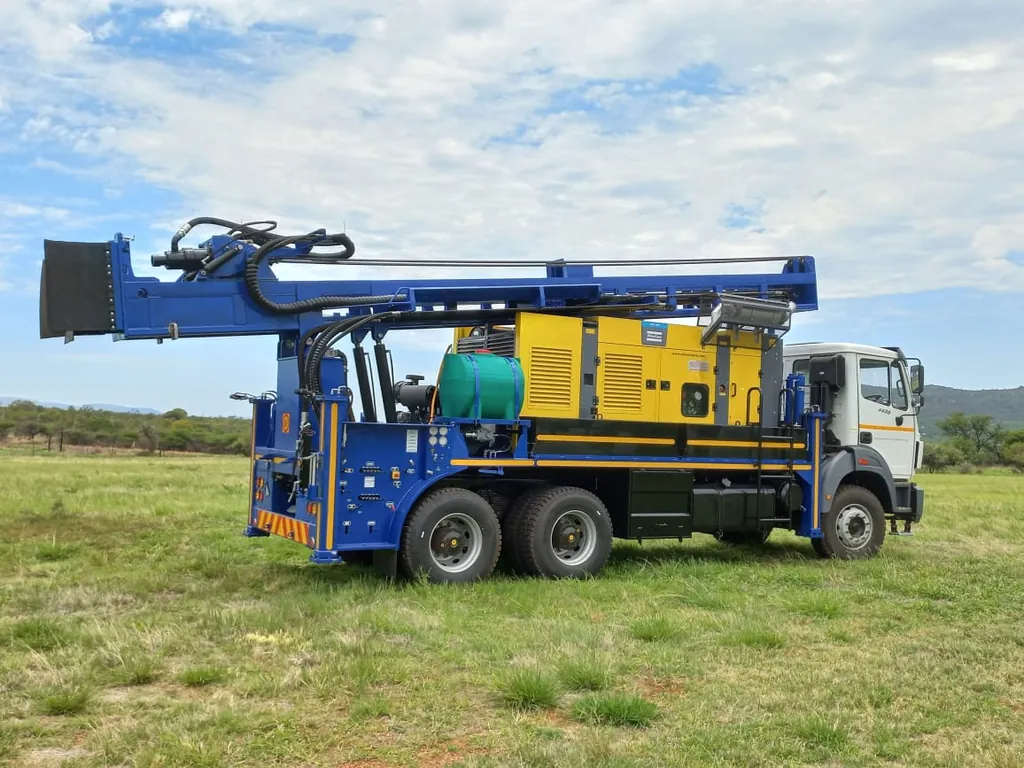
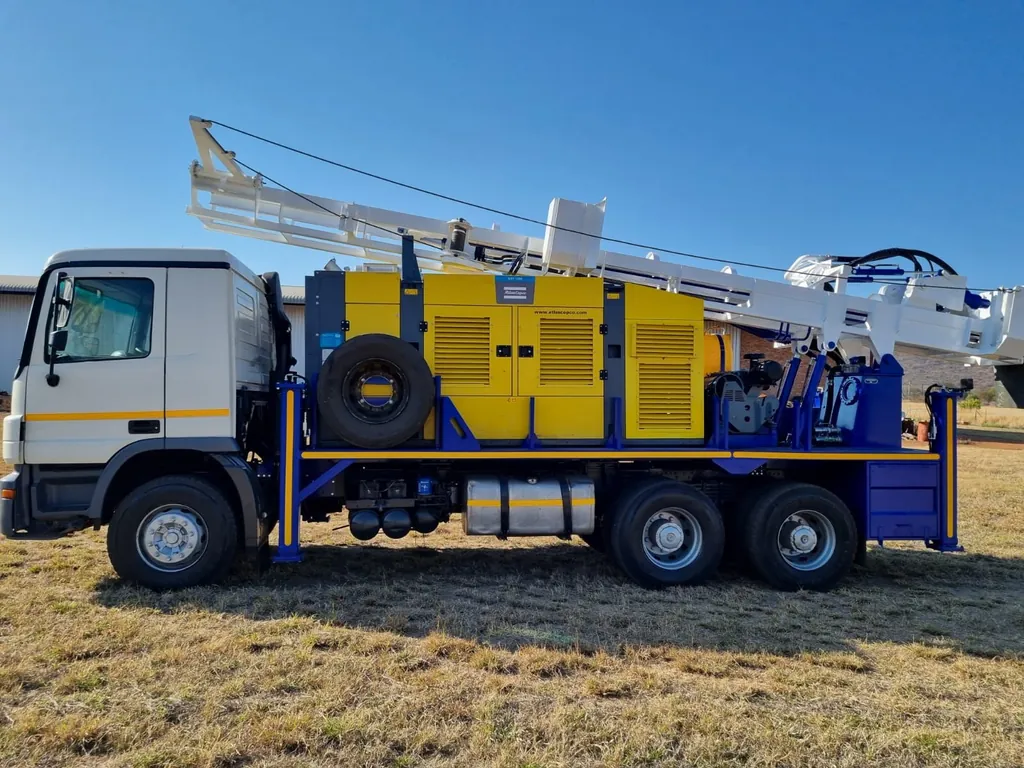
The SAR200 is our versatility flagship: DTH and RC configurations on one platform, dual piston pumps at 250 bar, and the chain-fed tower that keeps it welcome on height-restricted sites. The A200 is the premium simplicity play: the Staffa HMB100 head on a double bearing box, driven along a 6.35 m direct-on-cylinder feed — the longest direct stroke in our range — with no chains anywhere in the feed path.
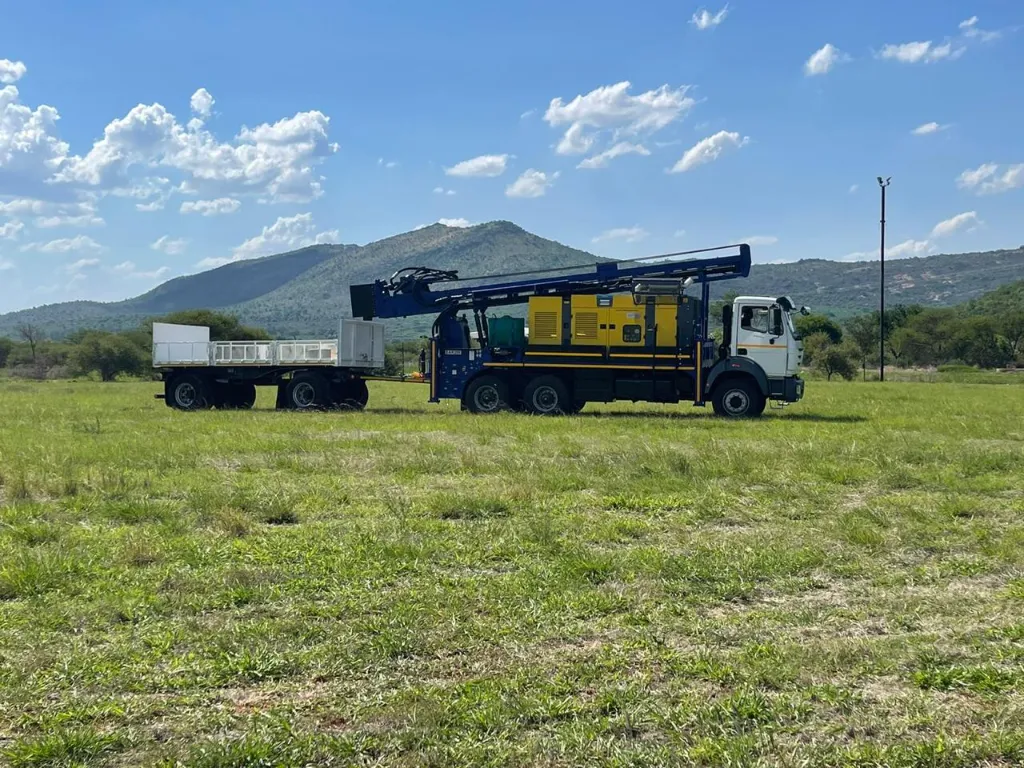
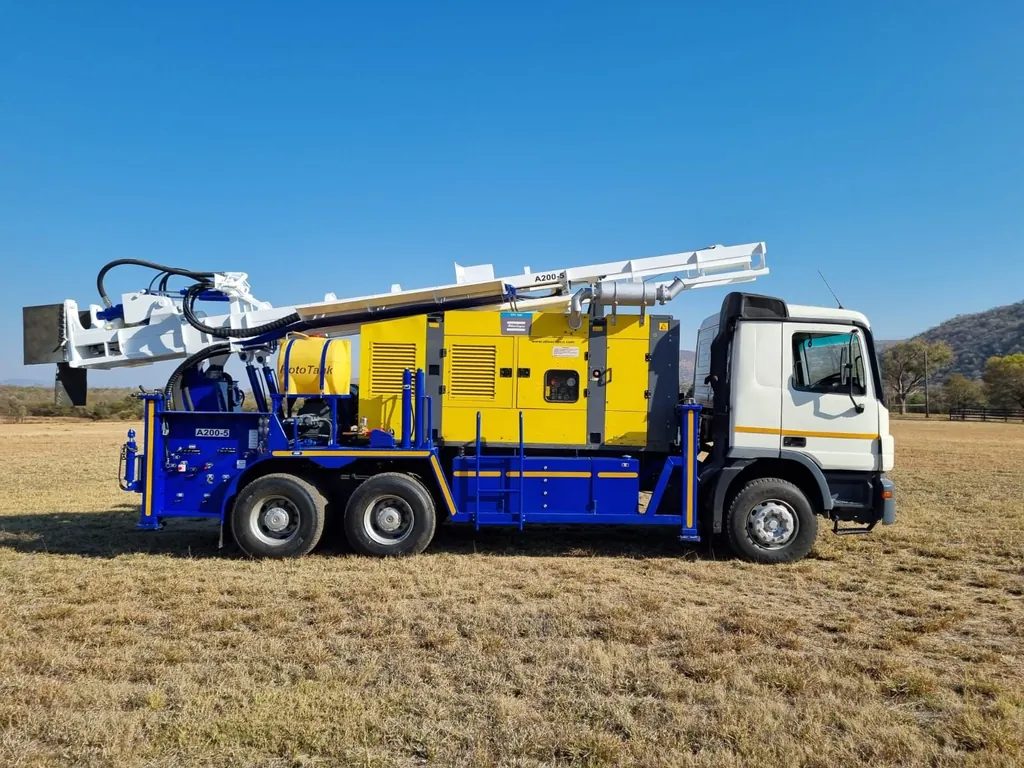
The comparison, with the numbers we stand behind
| SAR200 | A200 | |
|---|---|---|
| The one-line difference | The functional choice: chain-fed, lighter, and the tower never grows taller than itself while drilling | The reliability choice: direct feed with fewer moving components — no chains in the feed path at all |
| Rated depth | 400 m | 400 m |
| Max hammer | Up to 10 inch | Up to 10 inch |
| Rotary head | Identical options on both rigs — Staffa HMB100 (5,300 Nm) or geared head (6,000 Nm) | Same — Staffa HMB100 with double bearing box, or the geared head |
| Feed system | 125 mm bore × 80 mm shaft cylinder driving a leaf-chain tower at 1:2 — the head travels 2 m for every 1 m of cylinder, giving 7 m of head travel and double feed speed | 100 mm bore × 80 mm shaft cylinder, direct on the cylinder, 1:1 — a 6.35 m stroke, the longest direct stroke in our range, with no chains to wear or adjust |
| Tower height while drilling | Constant — the head travels inside the tower, so the rig never stands taller than its tower | The cylinder extends past the tower: ±13–13.5 m at full extension typical value |
| Drill rods | 6 m rods with ease — 7 m of travel leaves a full metre of working room | Takes 6 m rods, but we prefer to sell it with 5 m rods so real workspace remains under the rotary head |
| Pull-back / push-down | ±15,340 / ±9,055 kgf at 250 bar | ±15,700 / ±5,655 kgf at 200 bar |
| Hydraulics | Dual piston pumps, 250 bar | Piston pumps, 200 bar |
| Rig weight (excl. compressor) | ±7 t | ±8 t |
| Outriggers | 4× boxed, 1,200 mm stroke | 4×, 1,200 mm stroke |
| Rods carried with compressor on board | ±100 m — the lighter tower leaves more truck payload for rods typical value | ±54 m typical value |
| Dump tower option | Available — vertical tower-height adjustment for casing work, welding space and angle drilling (it does not tip anything out) | Available — same function |
| RC (reverse circulation) | Available — the established RC package (RC Box head, cyclone, RC rods) | Also available by changing the rotary head — on either rig the RC conversion is an expensive component set, which is why RC configurations cost more |
| Truck | Powerstar or equivalent 6×4 / 6×6 | Powerstar or equivalent 6×4 / 6×6 |
| Best fit | Height-restricted work (mines, excavator-rig adaptations), RC exploration on the proven package, and buyers who want maximum push-down and feed speed | High-utilisation fleets that prize simplicity: fewest moving parts in the feed path, the premium head, and the longest direct stroke we build |
No prices in this table on purpose: rig pricing moves with truck, compressor and tooling choices, so we quote per configuration — ask and you get a full drill-ready quotation, not a starting-from number.
What the feed system actually decides
A leaf-chain feed at 1:2 is a force and speed multiplier: the SAR200’s 125 mm cylinder moves 3.5 m and the chain doubles that into 7 m of head travel, at twice the cylinder’s speed. Run at 250 bar through dual piston pumps, it also posts the bigger push-down number — ±9,055 kgf against the A200’s ±5,655 — which earns its keep in collapsing ground and sticky formations where you genuinely lean on the bit. The price of that multiplication is the chain itself: leaf chains are proven, hard-wearing components, but they are moving parts that stretch, need inspection and adjustment, and one day need replacement.
The A200 deletes that whole family of parts. The head bolts to the cylinder and the cylinder is the feed — a 1:1 relation with nothing between the hydraulics and the head. Fewer moving components means fewer things that can give trouble: that is the A200’s entire argument, and for a rig that drills every day far from the workshop it is a strong one. The trade is that the cylinder must physically span the stroke, so the extended rig stands ±13–13.5 m tall typical value — and the direct cylinder’s annulus sets a gentler push-down. On free-running DTH work, where the hammer does the work and the string mostly hangs on pull-back, you will rarely feel that difference; in formations where you push, you will.
One tower grows, one does not
Because the SAR200’s head travels inside the tower on the chain, the rig never stands taller than the tower it arrived with. That sounds like a footnote until you drill where height is regulated or physically capped: mine sites with machinery height limits, works under power lines, and the excavator-mounted rig conversions we build — all places where the SAR200’s constant height is the reason it gets the job. The A200’s cylinder extends past the tower to ±13–13.5 m at full stroke typical value — no issue at all on open ground, a hard stop where the site says no.
The rod length question is the same trade seen from below. Both rigs take 6 m rods, but the SAR200’s 7 m of travel leaves a full metre of working room over the string, while a 6 m rod inside the A200’s 6.35 m stroke leaves very little space under the rotary head. So our honest advice on the A200 is 5 m rods: you give up a little per-rod length and keep real workspace at the table.
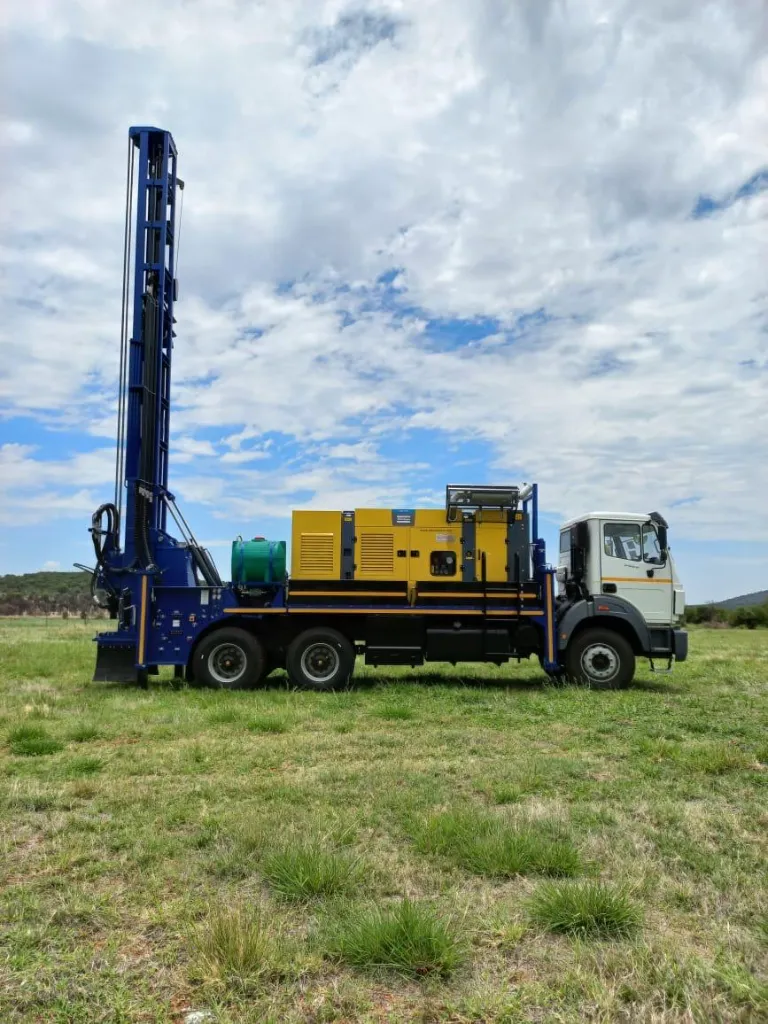
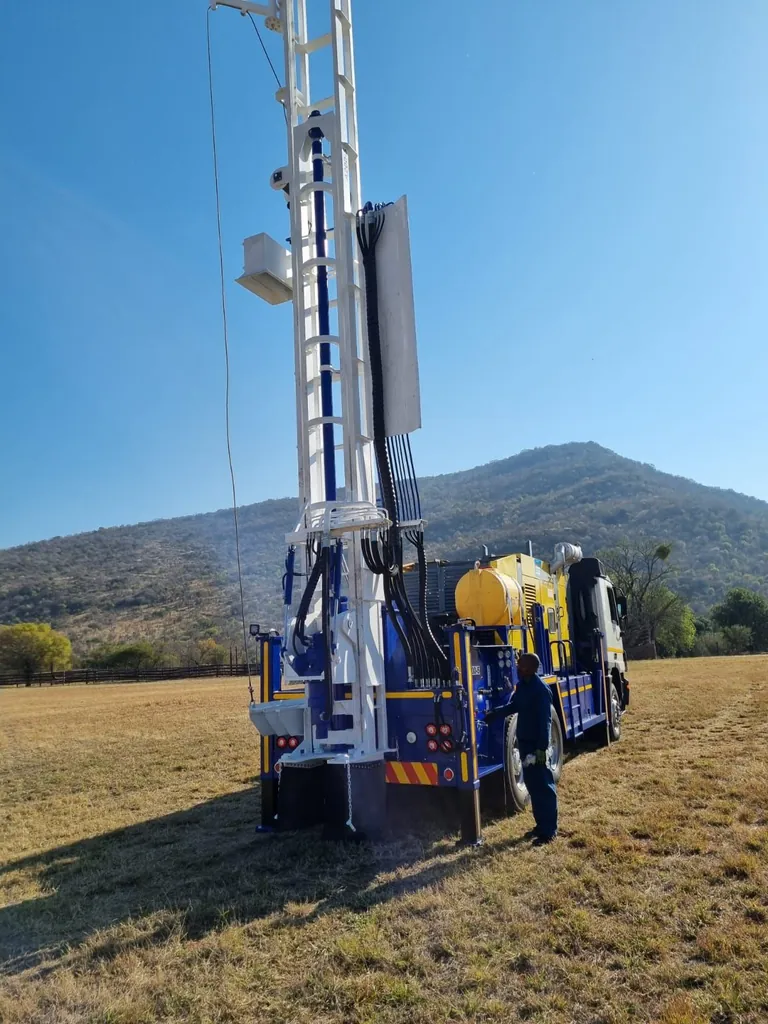
Where to put the compressor
Both rigs are offered with the compressor on board or separate, and the on-board versions photograph beautifully: one truck, everything on it. So it surprises buyers that our usual advice — for either rig — is the opposite: put the compressor on its own truck and load the rig with rods.
Two reasons, both learned the unglamorous way. First, dust: an on-board compressor lives next to the borehole and breathes what the hammer blows out of it, so its filters block far faster; a separate compressor truck parks upwind of the dust and its filters last far longer. Second, weight and space: a compressor on the deck is standing exactly where drill rods should ride. With the compressor on board, the SAR200 still loads about 100 m of rods — its lighter tower leaves more payload — and the A200 about 54 m; either way, the balance of a 400 m string must follow on a trailer or the support truck. typical value Separate the compressor and both rigs carry their rods where they belong: on the rig, at the hole.
Four questions that settle this pair
The eight-question checklist on our SAR100 vs SAR200 page compares any two rigs. For this particular pair, four questions do the deciding:
Does any site cap your height?
Mine work, power-line proximity, machinery height limits, or an excavator-rig conversion in your future — any yes points at the SAR200’s constant-height tower.
Do your formations make you push?
Collapsing ground, clays and sticky drilling reward the SAR200’s ±9,000 kgf push-down. Free-running DTH in hard rock rarely uses either rig’s full push.
What do you want to maintain?
A leaf chain is proven but is a wearing, stretching, adjustable part. If your rig works far from support and every day counts, the A200’s chain-free feed is the whole reason it exists.
Is RC in your plans?
Both rigs can run RC by changing the rotary head, and on either rig that conversion is an expensive component set. The SAR200’s RC package is the established, proven route — if exploration sampling is the business plan, start there.
What we are deliberately not telling you
- No prices on this page. Not coyness — configuration honesty. Truck, compressor, tooling and trailer choices move the total substantially, so a single number here would mislead. Ask and you get a full itemised quotation. no published figure
- No A200 deck-engine figure. The A200’s deck engine is specified per build and we have not published a single figure — ask for the spec on your quotation. (The SAR200’s is the Deutz F6L914, turbo intercooled, 130 kW.) no published figure
- No penetration rates. Metres per hour depends on formation, hammer, air pressure and operator — any single figure would be marketing, not engineering. Local drillers in your area are the honest source. no published figure
- Rod capacities are configuration-typical. The ±100 m and ±54 m figures assume the compressor on board and move with truck choice, rod diameter and tooling — confirm against your configuration. typical value
- Force figures are cylinder-derived. Pull-back and push-down are calculated from cylinder bore, shaft and working pressure — the honest engineering way to state them — not measured on a load cell per machine. verify with maker
Tell us where you plan to drill
Describe the work — the depths, the formations, the sites and their height limits — and we will tell you plainly which of these two machines fits, and quote it drill-ready. Both are designed and built in our Mokopane workshop, and you are welcome to visit and watch them being built before you decide. Most serious buyers do.
Ask which 400 m rig fitsJoin the conversation
Questions or an opinion on this article? The discussion happens on our Facebook page.
Share & comment on FacebookVisit our Facebook page