
Solar farms live or die on their foundations. Get the piles right and the array stands square and stable for 25 years; get them wrong and you face re-drills, re-levelling and slipped construction deadlines. As utility-scale and commercial solar accelerates across Southern Africa, more contractors are asking the same question: what does it actually take to install solar piles quickly, accurately and across the mixed ground you find on a real site? Here is a practical look at how solar piling works, the methods available, and what to look for in a piling rig.
How solar piling foundations work
Almost every ground-mounted solar structure sits on driven or drilled steel piles - usually C, I or W sections, or galvanised tube. The pile does two jobs: it transfers the weight of the panels and racking into the ground, and it resists the uplift and lateral loads that wind puts on a large, sail-like array. Two numbers dominate the design:
- Pile depth - typically 1.5 m to 3.5 m of embedment depending on soil strength, wind zone and panel height. Deeper, weaker ground needs longer piles; competent ground needs less.
- Pile diameter / section - commonly 75 mm to 120 mm equivalent. The section is chosen for structural load, but it also dictates how much energy you need to install it.
Get embedment and verticality within tolerance on every pile - often thousands per site - and the racking goes up fast. Miss tolerance and every downstream trade slows down.
Soil types: why one site needs several methods
The catch is that a single solar site rarely has a single soil. You can start the morning in soft, sandy overburden where a pile almost drives itself, and hit weathered rock or calcrete by lunchtime. That variability is exactly why method matters:
- Soft to medium soils - ideal for direct driving (ramming) the pile, which is fast and needs no spoil removal.
- Dense, gravelly or stony ground - often needs a pre-drilled hole (auger or rotary) before the pile is set or driven.
- Weathered or hard rock - calls for down-the-hole (DTH) hammer drilling to cut a clean socket the pile can be set into.
Auger vs DTH vs ramming
Augering uses a rotating flight to cut and lift spoil out of softer ground - quick and clean where the soil cooperates, but it struggles in rock. DTH drilling puts a percussive hammer at the bottom of the string, breaking hard rock efficiently while compressed air clears the cuttings - the go-to for competent rock sockets. Ramming drives the pile directly with a high-energy hydraulic hammer; in suitable ground it is the fastest method of all because there is no hole to drill and no spoil to handle.
The key insight is that these methods are complementary, not competing. The most productive solar crews are the ones who can switch method to suit the ground in front of them without switching machines.
Why one rig should handle both drilling and driving
If drilling and driving live on two separate machines, every change in ground conditions means mobilising a second rig, a second operator and more time lost to repositioning. A platform that can auger, DTH-drill and accept a pile rammer - on one compact, manoeuvrable chassis - keeps the crew moving down the row regardless of what the soil does. That flexibility is the single biggest lever on solar piling productivity.
The Drillbuilders answer: JCS500 + 1800 J pile rammer
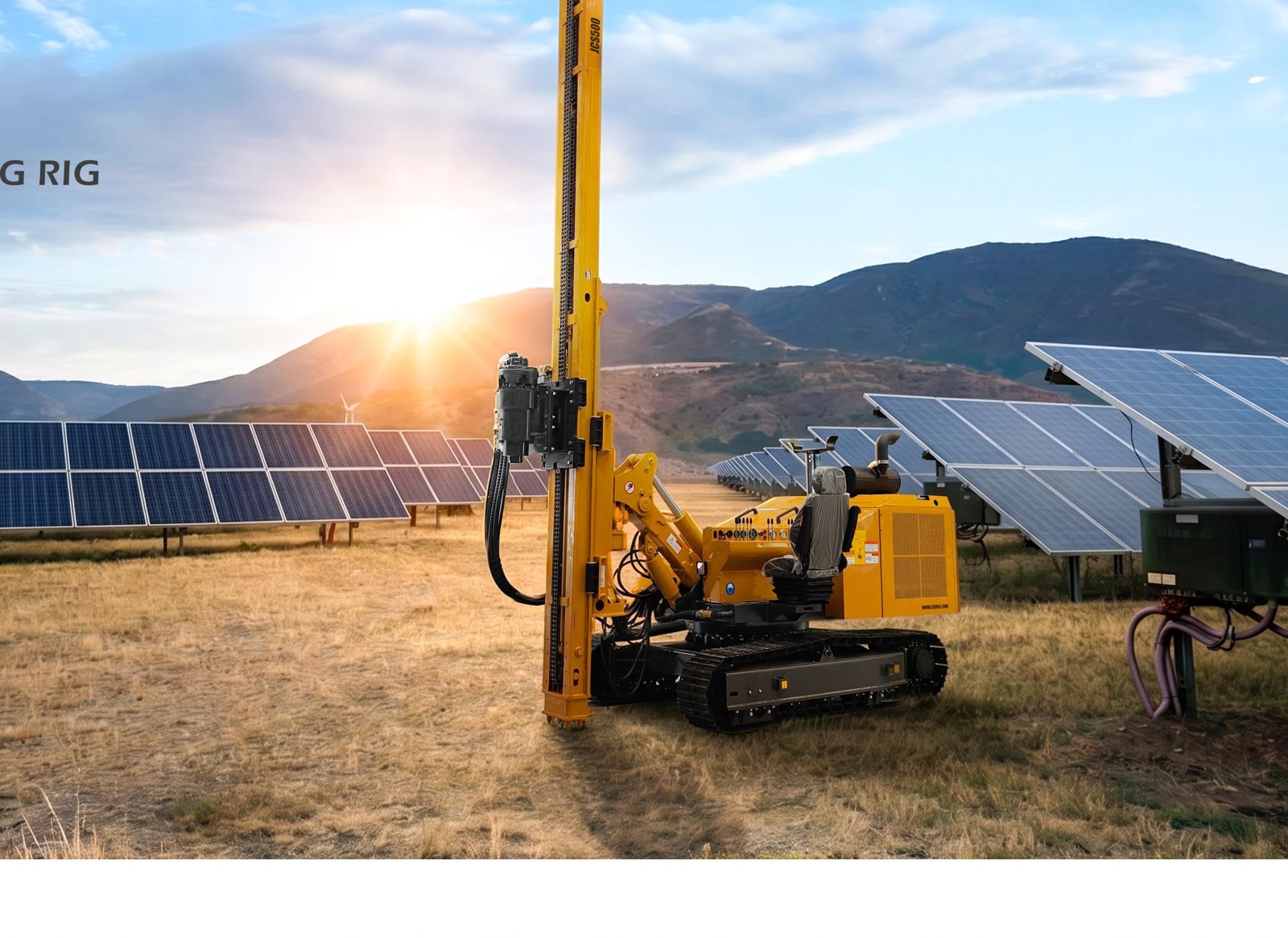
This is exactly why we built the JCS500 Solar Piling Rig. It is a compact crawler platform designed for solar PV foundation work, combining auger and DTH drilling with a 360-degree rotating chassis so the operator can drill, reposition and set piles without constantly tramming the machine. Paired with our Hydraulic Pile Rammer (1800 J), the same rig drives solar piles directly where the ground allows - giving one crew the full range of methods on a single machine.
Spec at a glance
- JCS500: auger + DTH drilling, up to 4 m piles, 360-degree rotating chassis, 85 kW Cummins power.
- Hydraulic Pile Rammer: 1800 J impact energy, 350-800 blows per minute, drives 75 / 85 / 100 mm solar piles. Sold separately.
Whether your next site is soft sand, stony overburden or weathered rock, the JCS500 is built to keep your crews productive across all of it.